The topic AWS Summit Seoul 2026: Korean Enterprises And Agentic AI is currently the subject of lively discussion — readers and analysts are keeping a close eye on developments.
This is taking place in a dynamic environment: companies’ decisions and competitors’ reactions can quickly change the picture.
Posted on May 21
• Originally published at todea.co.kr
Over the last few years, people have been asking the same question about AI: with so much money going into models, GPUs, and data centers, when will it pay off? Earnings calls and analyst reports have often mentioned a possible bubble, and companies that tried generative-AI pilots in 2024 have been waiting to see real production results.
At AWS Summit Seoul 2026, Samsung Electronics, Yogiyo, and Yanolja presented production-oriented agentic-AI/AIOps cases, while KB Kookmin Bank presented a production-scale KBaaS API-infrastructure modernization case. Together, the sessions showed how Korean enterprises are applying AI-era cloud architecture to operations, development, and embedded finance. Here’s a summary of how the event was organized, what the enterprise sessions showed, which AWS tools were most common, and the key patterns you can apply to your own plans.
AWS Korea CEO Ham Ki-ho opened the event by outlining three stages: Generative AI, Agentic AI, and Physical AI. He described Agentic AI as the active phase, where large language models act as reasoning engines that plan, use tools, and take action, instead of just answering prompts. Physical AI was presented as the next step, with a new Physical AI Frontier Program for Korean robotics, AI-chip, and manufacturing companies. This program will support everything from data collection to edge inference and help with global expansion.
AWS CFO Jon Felton announced a cumulative ₩12.6 trillion investment plan in Korea by 2031, described publicly as the largest-ever investment in Korea by a global cloud provider, with an estimated ₩15.06 trillion contribution to Korea’s GDP between 2023 and 2027. The Industry Day talks that followed showed how this commitment will play out in practice.
The keynote also highlighted the main agentic tools AWS featured at the event, with Vice President Jason Bennett explaining each one:
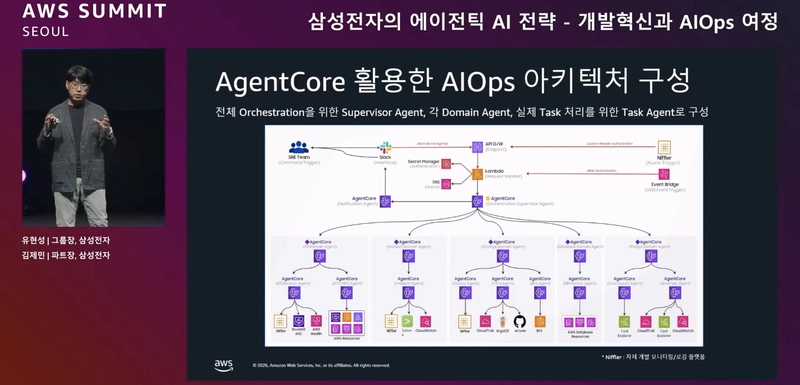
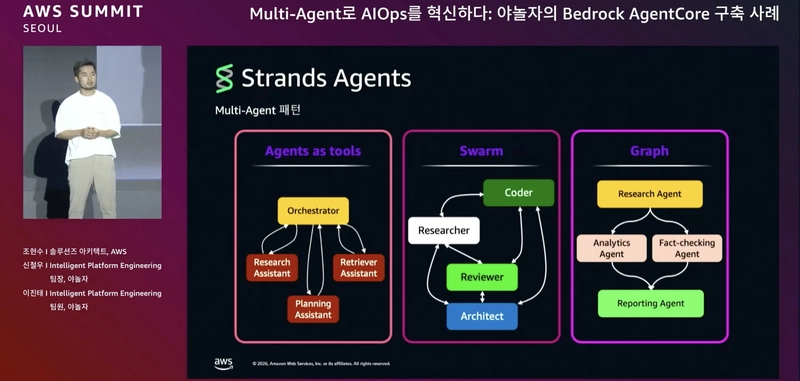
Across the agentic-AI sessions, a pattern emerged, but it was not universal. Samsung and Yanolja both used a supervisor or core-agent structure that delegates work to specialist agents. Yogiyo showed a Bedrock AgentCore-based AIOps workflow connected to operational data and tool functions. KBaaS was different: an EKS-based API platform and gateway modernization for embedded finance.
The numbers made it clear these were real deployments, not just experiments. Samsung Electronics used Samsung Account, which supports 2.1 billion users, over 50 services, more than 2.7 million requests per second, and 200,000 transactions per second across four regions on EKS with over 70 namespaces. Samsung set Day-1 AIOps goals including 90%+ MTTR reduction, 99% incident detection within 10 minutes, and reducing human-in-the-loop operational work below 20%, as part of a roadmap toward ‘Toil 0% / Human First.’ KB Kookmin Bank’s KBaaS platform now handles about 1,800 APIs and 200 million calls per day after switching from a third-party API gateway to their own on AWS EKS. Yogiyo showed how they moved from checking multiple consoles and logs during incidents to using an AgentCore-based AIOps loop, which brings metric observation, correlation analysis, change-history comparison, and RCA grounding into one workflow. Yanolja shared the most technical details, describing how their domain-specialist agents for DevOps and SRE are managed by a Core Agent on Bedrock AgentCore Runtime, using Strands Agent as the SDK and end-to-end authentication.
Samsung, Yogiyo, and Yanolja all centered their agentic-AI cases on AIOps or infrastructure operations rather than customer-facing copilots. KB Kookmin Bank’s case showed a different but related production pattern: modernizing a high-volume API platform on EKS for embedded finance.
On the development side, the counterpart is AI-DLC (AI-Driven development Lifecycle), which is AWS’s approach to AI-led development with humans checking at validation and final approval. Samsung saw a 70% reduction in lead time using this method, and LG Electronics’ MS division reported double the productivity. The main idea is to separate intent from execution: humans decide what should happen and check the results, while agents handle the steps in between.
A few key components showed up again and again in the enterprise sessions:
Several patterns stood out during the day. First, the supervisor pattern appeared twice independently. Samsung and Yanolja reaching the same structure without coordination is a strong signal. Second, in three of the four cases (Samsung, Yogiyo, Yanolja), the entry point was AIOps or infrastructure operations rather than customer-facing copilots. KB Kookmin Bank instead modernized its API platform on EKS for embedded finance. Third, humans are intentionally kept in the loop. Datadog’s session made this clear, stating that sovereignty and judgment remain with people, while agents handle execution via the Datadog AI Agent Builder. Samsung’s AI-DLC approach on the development side followed the same principle. Fourth, infrastructure needs to catch up. GS Neotek’s session highlighted that the real GPU issue in agent workloads is not a shortage but poor utilization, excessive idle time, and over-allocation. They suggested using Dynamic Resource Allocation (DRA) on EKS as a next-generation operations model that considers workload needs, sharing policies, and topology.
Templates let you quickly answer FAQs or store snippets for re-use.
Are you sure you want to hide this comment? It will become hidden in your post, but will still be visible via the comment’s permalink.
For further actions, you may consider blocking this person and/or reporting abuse
Todea is a Seoul-based cloud-native engineering consultancy. We assess, build, and operate production Kubernetes platforms for enterprises across Korea, Japan, and APAC.
Thank you to our Diamond Sponsors for supporting the DEV Community
Google AI is the official AI Model and Platform Partner of DEV
DEV Community — A space to discuss and keep up software development and manage your software career
Built on Forem — the open source software that powers DEV and other inclusive communities.
We’re a place where coders share, stay up-to-date and grow their careers.