The topic The Connected Agent: Scaling Antigravity 2.0 with Google Cloud Data Services and… is currently the subject of lively discussion — readers and analysts are keeping a close eye on developments.
This is taking place in a dynamic environment: companies’ decisions and competitors’ reactions can quickly change the picture.
Artificial Intelligence is rapidly evolving from chatbots to autonomous agents capable of reasoning, planning, and taking action. But an AI agent is only as useful as the data and tools it can access.
Introduced as Google’s next-generation agent development platform, Antigravity 2.0 enables developers to build multi-agent systems, orchestrate long-running workflows, and seamlessly integrate enterprise tools. When combined with Model Context Protocol (MCP) ** and **Google Cloud Data Services, it provides a scalable architecture for building production-ready AI applications.
In this article, we’ll explore how these technologies work together and why they represent a modern blueprint for enterprise AI.
The original Antigravity, released in November 2025, was a smart coding assistant wrapped around a familiar editor. Version 2.0 is a different category of product entirely. Instead of centering the code editor, it centers the agent itself, shipping simultaneously as a standalone desktop command center, a CLI (agy), an SDK, and a managed agents tier inside the Gemini API.
Underneath all of it sits Gemini 3.5 Flash, tuned specifically for agentic workflows and reportedly running several times faster than the previous generation while holding long context. That speed matters more than it sounds like it should when you’re running multiple agents in parallel, each one waiting on a database schema lookup or a query result, latency compounds fast. A model that responds in milliseconds instead of seconds is the difference between a fluid multi-agent workflow and a stalled one.
The architecture reflects this shift toward orchestration. A manager agent breaks an incoming task into subtasks. Specialized sub-agents then work in parallel one writing code, one running terminal commands, another driving a real embedded Chromium browser to click through the UI it just built and catch what’s broken. It’s less “autocomplete” and more “team of engineers,” each with a narrow job and a shared plan.
None of that matters much, though, if the team can’t see your data.
A traditional chatbot would struggle because the information lives across multiple systems.
Query BigQuery for sales analytics. Retrieve customer orders from Cloud SQL. Check shipping status through an external API. Search policy documents stored in Cloud Storage. Send notifications. Remember previous conversations.
Writing custom integrations for every application quickly becomes difficult to maintain.
Instead, modern AI systems separate reasoning from tool execution.
Antigravity 2.0 is Google’s platform for building intelligent agents that can reason, collaborate, and execute complex workflows.
Instead of relying on a single AI assistant, Antigravity 2.0 enables teams to orchestrate multiple specialized agents that work together.
🤖 Multi-agent orchestration 🧠 Long-running reasoning 🔄 Dynamic task decomposition 🛠 Native MCP tool integration 💻 Antigravity CLI and SDK ☁️ Deep integration with Google Cloud 📊 Enterprise-ready deployment patterns
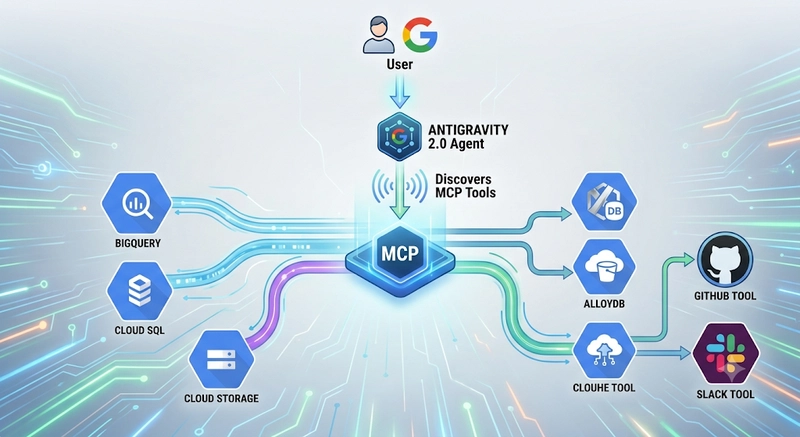
Rather than directly accessing databases or APIs, Antigravity agents invoke MCP tools to retrieve data or perform actions securely.
Instead of building custom integrations for every database or API, each capability is exposed as an MCP server.
The agent discovers available tools and invokes them dynamically.
User │ ▼ Antigravity 2.0 │ Discovers MCP Tools │ ─────────────── BigQuery Tool Cloud SQL Tool AlloyDB Tool Storage Tool GitHub Tool Slack Tool ───────────────
The result is a modular architecture where agents remain lightweight while integrations evolve independently.
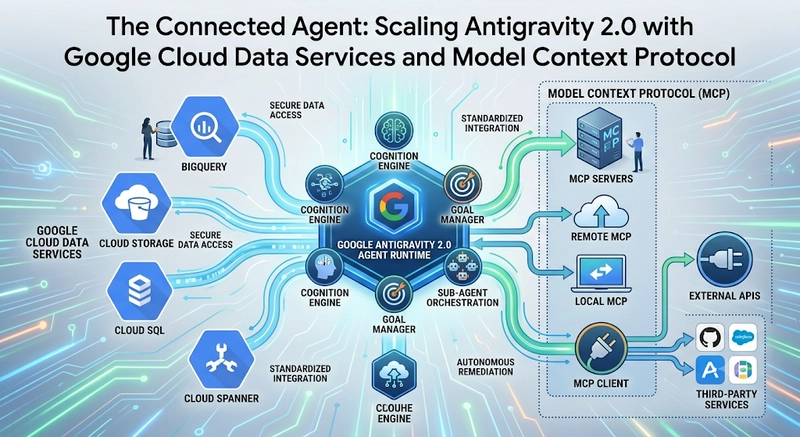
The real strength of Antigravity 2.0 comes from combining intelligent orchestration with trusted enterprise data.
Antigravity selects the BigQuery MCP tool. SQL is executed. Results are summarized using Gemini. The user receives insights instead of raw tables.
AlloyDB is ideal for AI applications that require both operational data and semantic search.
Vector search RAG applications Customer support Product recommendations
Agents can combine structured queries with semantic retrieval to generate highly contextual responses.
Most enterprise applications already rely on relational databases.
Instead of migrating data, organizations can expose Cloud SQL securely through MCP.
Contracts, reports, PDFs, manuals, and images often reside in Cloud Storage.
An MCP server can retrieve relevant documents and provide them as context to the agent.
User preferences Conversation history Application state Session data
This allows Antigravity agents to personalize every interaction.
Semantic cache Conversation memory Shared agent memory Rate limiting Session storage
Caching reduces latency and minimizes unnecessary LLM requests.
Imagine a customer support assistant built with Antigravity 2.0.
“My package hasn’t arrived. What’s happening, and am I eligible for compensation?”
Rather than relying on one agent, Antigravity orchestrates several specialized agents.
Imagine a customer support assistant built with Antigravity 2.0.
“My package hasn’t arrived. What’s happening, and am I eligible for compensation?”
Rather than relying on one agent, Antigravity orchestrates several specialized agents.
The orchestrator combines these outputs into a single response that is accurate, contextual, and personalized.
The orchestrator combines these outputs into a single response that is accurate, contextual, and personalized.
IAM Service Accounts Secret Manager Cloud Audit Logs VPC Service Controls Private Service Connect Customer-managed encryption keys (CMEK)
Since MCP servers expose only approved tools, organizations can apply least-privilege access and maintain strict security boundaries.
Combining Antigravity 2.0 with MCP creates several advantages:
As new business systems are introduced, developers simply deploy additional MCP servers instead of modifying the agents themselves.
If you’re building production AI agents, consider these recommendations:
Keep agents focused on reasoning rather than direct data access. Build small, reusable MCP tools with clear responsibilities. Secure every MCP server with IAM and least-privilege permissions. Cache expensive queries with Memorystore. Monitor agents using Cloud Logging and OpenTelemetry. Store credentials in Secret Manager. Version MCP tools to maintain compatibility. Add approval workflows before executing sensitive business operations.
Antigravity 2.0 marks an important step toward enterprise-ready agentic AI. Instead of building isolated chatbots, developers can create collaborative AI systems that reason, retrieve trusted business data, and automate complex workflows.
When paired with Model Context Protocol (MCP) and Google Cloud Data Services, Antigravity 2.0 enables secure, modular, and scalable AI architectures that are easier to build, govern, and extend.
The future of AI isn’t just smarter models ,it’s intelligent agents working together with the right tools, the right data, and the right architecture.
Templates let you quickly answer FAQs or store snippets for re-use.
Are you sure you want to hide this comment? It will become hidden in your post, but will still be visible via the comment’s permalink.
For further actions, you may consider blocking this person and/or reporting abuse
Join a global network of more than 1,000 professionals. Meet experienced Google technologies experts, influencers, and thought leaders. Explore the community, get advice, and network.
Thank you to our Diamond Sponsors for supporting the DEV Community
Google AI is the official AI Model and Platform Partner of DEV
DEV Community — A space to discuss and keep up software development and manage your software career
Built on Forem — the open source software that powers DEV and other inclusive communities.
We’re a place where coders share, stay up-to-date and grow their careers.